

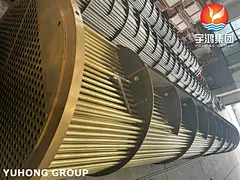
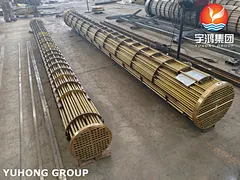


ASME SB171 C71500 Tube Bundle for High-Velocity Seawater Condensers
Overview: The Last Copper-Alloy Step Before Titanium
ASME SB171 C71500 (70/30 Cupronickel) Tube Bundle is a complete heat transfer assembly—tubes, tubesheets, baffles, and support plates—fabricated to TEMA and ASME requirements for condensers and heat exchangers operating in the most aggressive seawater conditions that still justify a copper-alloy solution. The governing standard for the tubesheet and internal plates is ASME SB171, which covers copper-alloy plate, sheet, and circles for pressure vessels, condensers, and heat exchangers; the tubes themselves are typically supplied to ASTM B111 / ASME SB111 in C71500.
The engineering decision that separates C71500 from its lower-nickel counterpart, C70600 (90/10 CuNi), is flow velocity tolerance. C71500 carries a design seawater velocity of 3.5 m/s, compared with 3.0 m/s for 90/10 and roughly 2.2–2.5 m/s for aluminum brass. In condensers where cooling-water pumps deliver high flow, tube-side velocity is pushed upward by fouling margin requirements or limited tubesheet area, 90/10 bundles can suffer inlet-end erosion and impingement attack before their nominal life is reached. C71500’s higher nickel content (29–33%) raises the threshold at which the protective film is mechanically stripped, extending service life in high-velocity or sand-laden seawater without moving to titanium or super-austenitic stainless steel.
For EPC contractors and shipyards, the bundle is procured as a drawing-based assembly, not a commodity tube order. The value lies in tube-to-tubesheet joint integrity, baffle spacing per TEMA, and documentation that satisfies the condenser’s design code. MOQ starts from 1 set, with lead times of 20–80 days depending on drawing complexity and material availability.
Application & Compliance: Where C71500 Bundles Are Specified
1. High-Velocity Main Condensers (Power & Marine)
Working Scenario: Coastal power plant surface condensers and shipboard main condensers where seawater velocity at tube inlets exceeds 2.5–3.0 m/s, or where future uprating is anticipated.
What it solves: Inlet-end erosion and impingement. The higher nickel content in C71500 maintains film stability under shear stress that would remove the protective layer from 90/10 CuNi. For a condenser designed at 3.0–3.5 m/s, C71500 is the correct copper-alloy specification; 90/10 is operating at its ceiling.
2. Offshore & Sour Service Condensers (NACE MR0175)
Working Scenario: Offshore platform cooling systems and FPSO condensers where the shell-side or tube-side fluid may contain wet H₂S, and the project specification invokes NACE MR0175 / ISO 15156.
What it solves: C71500 is available in NACE-compliant condition with hardness control and documentation. A complete bundle—C71500 tubes plus C71500 tubesheets to SB171—avoids the galvanic mismatch that arises when mixed materials are assembled without design review.
3. Desalination & Evaporator Service
Working Scenario: Multi-stage flash (MSF) and multi-effect distillation (MED) condensers where brine temperature and chloride concentration accelerate corrosion of lower-grade copper alloys.
What it solves: The 70/30 composition provides a higher tolerance to polluted or chemically variable seawater than 90/10, which is sensitive to sulfide-induced corrosion. The bundle is specified when the plant water intake is subject to seasonal quality swings or organic loading.
4. Why the Whole Bundle Matters (Not Just the Tubes)
A C71500 tube bundle procured to SB171/B111 as an integrated assembly eliminates a common field failure mode: galvanic couple between mismatched tube and tubesheet alloys. When C71500 tubes are rolled into a tubesheet of different composition (e.g., naval brass or 90/10), the tube-to-tubesheet crevice becomes the preferential attack site. Specifying C71500 tubesheets to SB171 alongside C71500 tubes keeps the electrochemical potential uniform across the joint, which is the design intent for high-reliability condensers.
Technical Specifications & Fabrication Scope
1. Bundle Configuration Parameters
| Parameter | Typical Range / Specification |
|---|---|
| Tube Material | C71500 (UNS C71500), 70/30 CuNi |
| Tube Standard | ASTM B111 / ASME SB111 |
| Tubesheet & Baffle Standard | ASME SB171 / ASTM B171 |
| Tube OD | 19.05 mm (3/4") standard; 12.7–25.4 mm available |
| Tube Wall | BWG 12–BWG 18 (custom per design pressure) |
| Tube Length | 1.5 m – 12 m |
| Bundle Type | Fixed tubesheet / U-tube / floating head (per drawing) |
| Design Code | ASME Section VIII Div.1, TEMA Class R/C/B |
| NACE Option | MR0175 / ISO 15156 compliant condition available |
2. C71500 Material Data (Tube & Tubesheet)
| Property | Value |
|---|---|
| Nickel (Ni) | 29.0–33.0% |
| Iron (Fe) | 0.4–1.0% |
| Copper (Cu) | Remainder (nominally 65%) |
| Tensile Strength | 350–550 MPa |
| Yield Strength (0.2%) | ~275 MPa (typical) |
| Design Seawater Velocity | Up to 3.5 m/s |
| Thermal Conductivity | ~45 W/(m·K) at 20°C |
3. C71500 vs. C70600: Velocity-Driven Selection
| Criterion | C70600 (90/10) | C71500 (70/30) |
|---|---|---|
| Design seawater velocity | 3.0 m/s | 3.5 m/s |
| Erosion resistance at high flow | Adequate to 3.0 m/s | Superior above 3.0 m/s |
| Sulfide-polluted seawater tolerance | Limited | Better |
| Relative material cost | Baseline | Higher (nickel content) |
| Correct application | Standard marine cooling, ≤3.0 m/s | High-velocity, sour, or variable-quality seawater |
QA/QC & Certifications: Documentation for Code-Stamped Bundles
A tube bundle is only as reliable as its tube-to-tubesheet joints. Quality control must address joint integrity explicitly, not just individual component certificates.
Tube-to-Tubesheet Joint Testing: Hydrostatic or pneumatic testing of the assembled bundle per TEMA requirements. Joint pull-out or expansion test records available on request.
Tube NDT: Eddy current testing of C71500 tubes per ASTM E243 (or hydrostatic alternative), with test reports traceable to heat numbers.
Tubesheet Material Certification: EN 10204 3.1 MTR for SB171 C71500 plate, with heat number and chemical composition.
Dimensional Inspection: Tube hole pattern, baffle spacing, bundle OD, and tube projection verified against approved drawings. Report included.
Third-Party / Class: SGS, BV, TUV, or Class surveyor (DNV/ABS/LR/CCS) coordination for 3.2 certification and release.
Installation & Maintenance Notes (For Shipyards and Plant Operators)
Handling the Bundle: C71500 bundles are heavier than equivalent 90/10 assemblies. Lifting points must be on the bundle shell or dedicated lifting lugs—not on individual tubes or tubesheet tube holes. Support the bundle during horizontal movement to prevent tube sag.
Tube-to-Tubesheet Joint Re-Rolling: If a joint leaks in service, re-rolling is possible with C71500, but the expansion zone must be cleaned and the roll torque controlled. Over-rolling work-hardens the tube end and can initiate stress corrosion cracking in sour service.
Seawater Velocity Verification: After installation, confirm that actual tube-side velocity at design flow does not exceed 3.5 m/s. A flow-induced vibration or erosion issue in a C71500 bundle is almost always a velocity-control failure, not a material shortcoming.
Lay-Up Protection: During extended shutdowns, drain and dry the tube side or fill with clean fresh water. Stagnant seawater in a C71500 bundle can promote under-deposit corrosion, particularly if sulfide-bearing silt settles in low-velocity zones.
Comprehensive score