
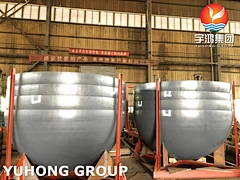
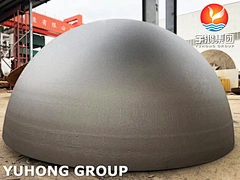
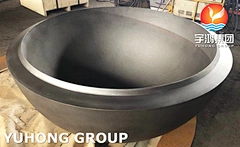
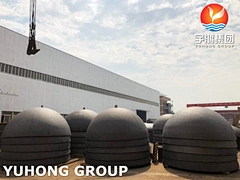
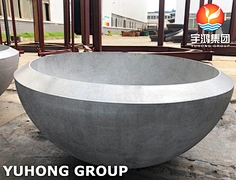
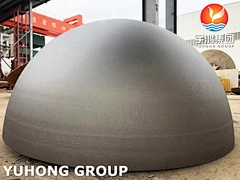
ASME SA516 Gr.70 Elliptical & Hemispherical Dish Head for Pressure Vessels and Storage Tanks
Overview: The End Closure That Governs Vessel Pressure Rating and Fabrication Cost
ASME SA516 Gr.70 Dish Head is a formed pressure-retaining end closure manufactured from normalized carbon steel plate to ASME Section II and Section VIII Div.1 requirements, supplied in 2:1 semi-elliptical and hemispherical configurations for pressure vessels, storage tanks, separators and gas/LPG bullets. The base material—SA516 Gr.70—is the workhorse pressure vessel plate grade: minimum tensile 485 MPa, minimum yield 260 MPa, with a carbon-manganese chemistry that provides a wide welding window and dependable notch toughness in moderate- and lower-temperature service.
The engineering decision between elliptical and hemispherical is not cosmetic. A 2:1 semi-elliptical head delivers approximately twice the depth-to-diameter ratio of a hemispherical head for the same diameter, meaning it occupies less vertical space and uses less plate area per unit of pressure rating—making it the economical default for the vast majority of horizontal and vertical vessels. A hemispherical head distributes internal pressure more uniformly and carries a lower stress intensification factor, making it the correct choice when pressure rating is the governing constraint, when the vessel requires a fully spherical end for stress uniformity, or when the available head height is not limited. The procurement reality is that neither shape is universally “better”; the drawing defines the shape, and the fabricator’s task is to deliver that shape within ASME profile tolerance, with a traceable plate certificate attached to the finished part.
For EPC contractors and vessel fabricators, the risk in sourcing formed heads is not material availability—it is whether the delivered head will fit the shell, meet the profile tolerance envelope, and arrive with NDT records that satisfy the vessel’s code stamp. This article addresses the procurement and technical control points that determine whether that happens.
Application & Compliance: Where Each Head Configuration Is Specified
1. 2:1 Semi-Elliptical Heads — Space-Constrained and Economical
Working Scenario: Horizontal separators, knockout drums, air receivers, LPG storage bullets, and vertical process vessels where the vessel diameter and tangent-to-tangent length are fixed by plot space or transportation limits.
What it solves: The shallower profile reduces overall vessel length and head plate consumption. For a vessel designed at moderate pressure (typically up to ~2.0 MPa for LPG service, higher for process vessels depending on diameter and thickness), the 2:1 elliptical geometry provides adequate pressure retention without the extra head height and plate area of a hemispherical end.
2. Hemispherical Heads — Pressure-Uniformity and High-Rating Service
Working Scenario: High-pressure accumulators, spherical storage tanks, reactor shells, and vessels where the end closure must carry the same membrane stress regime as the cylindrical shell with minimal discontinuity stress.
What it solves: The hemispherical geometry develops nearly uniform membrane stress under internal pressure, reducing the required thickness relative to an elliptical head for the same design pressure and diameter. It is the specified shape when pressure rating and stress uniformity govern over space economy.
3. SA516 Gr.70 as the Base Material — Why It Fits Both Shapes
SA516 Gr.70 is specified for these heads because it combines three properties that matter in formed closures: (a) adequate strength at moderate wall thickness, avoiding the need for alloy steel in standard service; (b) good cold-forming and hot-forming response, allowing the head to be produced by pressing, cold spinning, or hot spinning depending on diameter and thickness; and (c) weldability compatible with the shell material, so the circumferential seam does not require a dissimilar-metal welding procedure. Normalized delivery (SA516 Gr.70N) is available when the purchase specification requires enhanced toughness or when post-forming property recovery is mandated.
4. Shape Tolerance: The Acceptance Criterion That Often Gets Missed
ASME Section VIII Div.1 UG-81(a) sets the profile tolerance for ellipsoidal heads: the formed surface shall not deviate outside the specified shape by more than 1¼% of the inside diameter, nor inside the specified shape by more than ⅝% of the inside diameter. Hemispherical heads are checked against the same principle of shape conformity. This tolerance is not a fabricator preference—it is a code acceptance criterion. A head that is dimensionally correct at the flange but deviates beyond the UG-81 envelope in the crown or knuckle region creates fit-up and stress-distribution problems that cannot be corrected at the vessel shop. Procurement documents should explicitly require a profile check report (template or laser scan) against UG-81, not merely a diameter and depth measurement.
Technical Specifications & Selection Logic
1. Formed Head Dimensional & Manufacturing Scope
| Parameter | Specification / Capability |
|---|---|
| Base Material | SA516 Gr.70 / Gr.70N (ASME Section II) |
| Head Types | 2:1 semi-elliptical; hemispherical |
| Diameter Range (typical) | 300 mm – 6,500 mm (larger by arrangement) |
| Thickness Range | 6 mm – 80 mm (forming route dependent) |
| Forming Methods | Cold spinning; hot spinning; pressing (per diameter/thickness/geometry) |
| Flange Edge Preparation | Trimmed, beveled, or tapered per drawing |
| Heat Treatment | Normalizing, stress relieving, or as-formed per specification |
| Profile Tolerance | ASME VIII Div.1 UG-81: +1¼% D / −⅝% D |
| Marking & Traceability | Plate heat number transferred to finished head; layout marks and direction marks maintained through forming |
2. Elliptical vs. Hemispherical: Procurement Decision Matrix
| Criterion | 2:1 Semi-Elliptical | Hemispherical |
|---|---|---|
| Head depth (for equal D) | ~D/4 | ~D/2 |
| Relative plate consumption | Lower | Higher |
| Pressure rating for equal thickness | Adequate for moderate pressure | Higher pressure capability |
| Stress uniformity | Good; some discontinuity at knuckle | Excellent; near-uniform membrane stress |
| Typical governing constraint | Space and cost | Pressure rating and stress uniformity |
| Forming difficulty | Moderate (knuckle strain) | Higher (deep draw / large spun hemisphere) |
| NDT focus | Knuckle region and seam welds | Crown and seam welds |
3. Forming Route: Cold vs. Hot — The Cost and Property Trade-off
The forming route is not a shop-floor preference; it has direct procurement consequences. Cold spinning is economical for thinner heads and avoids the property reset associated with hot forming, but it introduces strain hardening and requires post-forming stress relief when the fiber elongation exceeds code thresholds. Hot forming (typically in the 900–1100°C range) facilitates thicker and larger heads but resets the mechanical properties, requiring re-normalizing after forming to restore the specified SA516 Gr.70 condition. Purchase specifications should state the required delivery condition (as-formed, stress-relieved, or normalized) and require the heat-treatment record to travel with the MTC. A head supplied “hot formed but not re-normalized” against a normalized specification is a documentation and property nonconformity, regardless of dimensional accuracy.
QA/QC & Documentation: What the Finished Head Must Arrive With
A formed head is a code component, not a shaped plate. The documentation package is part of the product.
Plate MTC (EN 10204 3.1): Heat number traceable to the finished head marking. The plate certificate must show SA516 Gr.70 chemistry and mechanical properties, including the specified toughness option if applicable.
Profile Inspection Report: Template or laser-scan verification against UG-81 tolerance envelope. Diameter at flange, crown height, and knuckle radius recorded.
Weld Seam NDT (where applicable): If the head is fabricated from more than one plate, the seam weld requires 100% radiographic testing (RT) per code and project specification. The NDT timing—before or after forming—should be agreed in the inspection and test plan (ITP); post-forming RT captures forming-induced defects, while pre-forming RT reduces repair hot work on the formed surface.
Post-Forming Surface NDT (if specified): UT per ASME SA-435 or PT/MT on weld edges may be invoked by project specification or by the vessel’s service requirements.
Heat-Treatment Record (if specified): Furnace chart and cycle parameters for stress relief or normalizing.
Dimensional & Visual: Flange circumference, edge preparation, surface condition (no harmful laps, tears, or forming cracks), and marking legibility.
B2B Purchasing Terms & Commercial Conditions
MOQ: 1 piece for drawing-based fabrication. Formed heads are project-specific components; tonnage-based MOQs do not apply.
Lead Time: 15–30 days typical for standard SA516 Gr.70 elliptical or hemispherical heads after drawing approval and deposit, depending on diameter, thickness, forming route and NDT scope. Larger or hot-formed heads may extend beyond this window.
Quotation Input Required: Head type (2:1 elliptical or hemispherical), inside or outside diameter basis, nominal and minimum thickness, straight flange height, edge preparation, quantity, design pressure/temperature, applicable code (ASME VIII Div.1), heat-treatment condition, and NDT scope. Price is drawing- and specification-dependent, not catalog-fixed.
Payment Terms: T/T and L/C accepted; confirmed at order based on project scope.
Packaging: Heads are shipped in cradles or on saddles with the flange face protected and the crown supported to prevent ovalization during ocean transit. Marking and heat-number identification remain visible on the external surface.
Documentation Package: Plate MTC (3.1), profile inspection report, weld seam RT report (if applicable), heat-treatment record (if specified), and dimensional inspection report. Third-party inspection (SGS/BV/TUV/Class) can be coordinated for 3.2 certification and hold-point release.
FAQ
Q1: How do we choose between a 2:1 elliptical head and a hemispherical head for a given vessel?
A: The governing variable is what limits the design: space and plate economy, or pressure rating and stress uniformity. For most moderate-pressure horizontal vessels and storage tanks, the 2:1 elliptical head is the economical default because it minimizes head height and plate consumption. When the design pressure requires a thicker shell or the vessel end must approach spherical stress uniformity, the hemispherical head is the correct specification. The drawing and design calculation should resolve the choice before RFQ; the fabricator’s role is to deliver the specified shape within tolerance.
Q2: What does ASME UG-81 tolerance actually require us to inspect?
A: UG-81(a) limits the formed surface deviation to +1¼% of D outside the specified shape and −⅝% of D inside the specified shape for ellipsoidal heads. In practice, this means a template or laser scan check across the crown and knuckle—not just a diameter measurement at the flange. A head that measures correctly at the flange can still be outside the UG-81 envelope in the crown. Require a profile inspection report as a deliverable.
Q3: If the head is hot formed, what documentation proves the SA516 Gr.70 properties are restored?
A: The heat-treatment record. Hot forming resets the plate’s mechanical properties; re-normalizing after forming is required to restore the specified SA516 Gr.70 condition. The purchase specification should state “normalized after forming” if that is the design requirement, and the MTC package should include the furnace cycle record. A dimensional certificate alone does not demonstrate property compliance.
Q4: When is RT of the head seam weld performed—before or after forming?
A: Code and project specification govern, but the technically defensible position is after forming: post-forming RT captures defects induced by the forming operation that pre-forming RT cannot detect. Pre-forming RT may be performed as an additional in-process check to reduce repair hot work, but it does not replace post-forming examination where the specification requires it. Agree the NDT sequence in the ITP before production begins.
Q5: Can you supply heads with nozzle openings, reinforcement pads, and beveled edges?
A: Yes. Openings, reinforcement pieces, direction marks, lifting provisions, and edge preparation (trimmed, beveled, or tapered) can be completed in the same production sequence before shipment. Provide the opening schedule and reinforcement details on the drawing; these operations affect the forming and NDT sequence and should be included in the RFQ scope.
Comprehensive score